Live-dealer games stream physical tables, while digital games use an RNG to determine outcomes; the formats and odds vary by game.
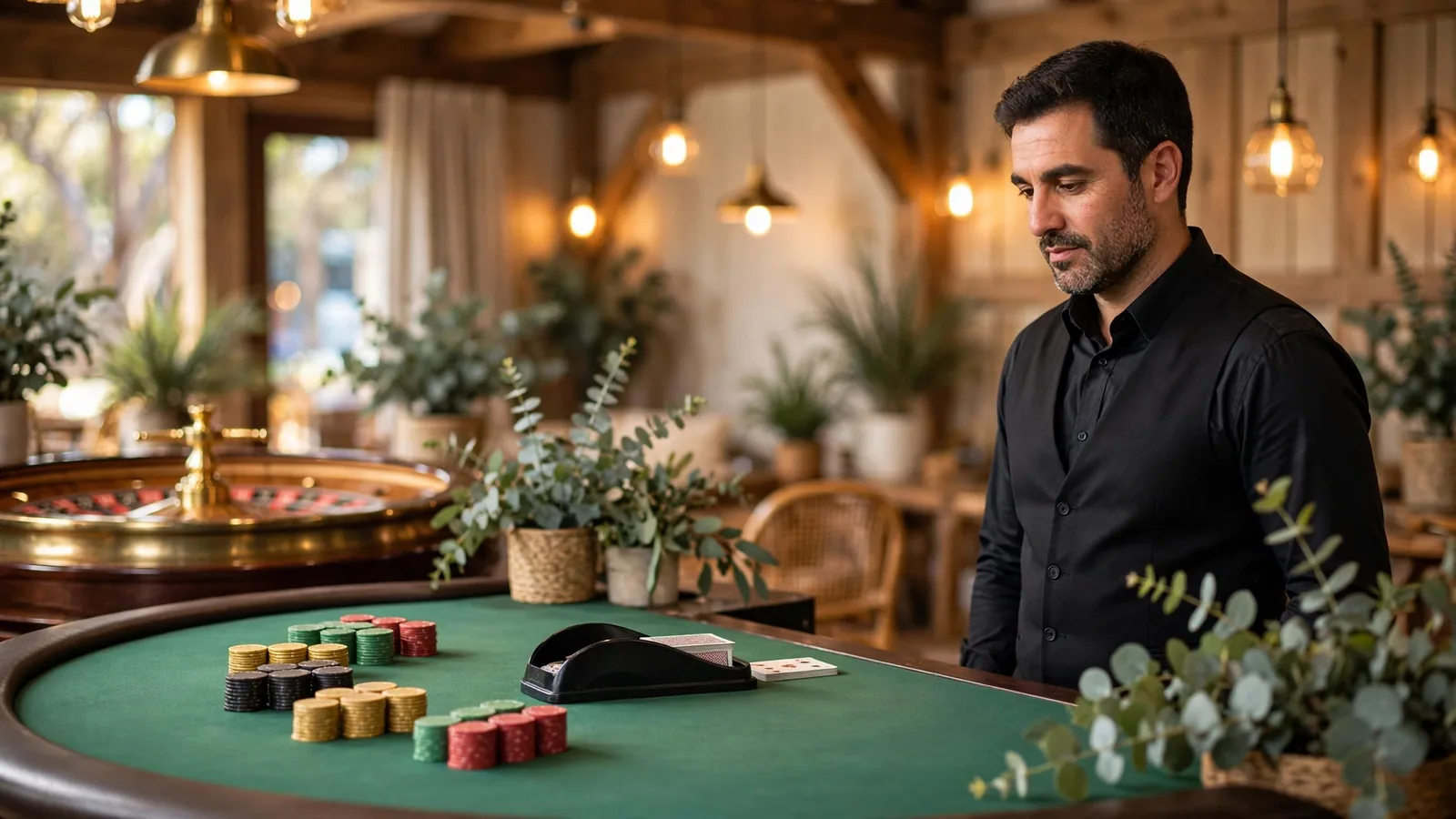
An online table game can be delivered in two quite different ways. In a live-dealer format, a real dealer works with real casino equipment while a camera streams the action to viewers. In a digital version, software uses a Random Number Generator (RNG) to determine the outcome. The screen may look like a table in either case, but the event behind it is not the same.
That distinction is useful when you are trying to understand what “live” means. It refers to a dealer and equipment being filmed as the game happens, not simply to polished graphics or an animated dealer on screen. The video brings the physical table to the viewer; the dealer’s actions and the equipment are part of what is being shown.
A digital table game, by contrast, does not rely on a streamed physical table to produce each result. Its RNG determines the outcome. For example, it can determine which cards are dealt or where a roulette ball lands. The graphics then present that result on screen. A digital interface can be designed to resemble a real table, but the visual style does not turn the game into a live broadcast.
Choosing a real-money casino for table games in Australia means checking the details that matter to you before you play. Use this list as a starting point and review each operator’s terms and availability for your circumstances.
Roby Casino
Roby Casino is listed with a Curacao eGaming licence held by Roby Games Ltd. Check the operator’s terms to see whether it suits your table-game needs.
Golden Pokies
Golden Pokies is listed with a Curacao licence. Review its terms and game information before deciding whether it fits your needs.
Ricky Casino
Ricky Casino lists crypto payouts in under an hour and PayID payouts in 1–3 business days. The minimum deposit is A$20, or A$30 to qualify for the bonus.
MrPacho
MrPacho lists crypto payouts in 30–120 minutes and fiat payouts in 24–72 hours. Its minimum deposit is A$30.
LevelUp Casino
LevelUp Casino lists a Curacao eGaming licence, OGL/2023/174/0082, held by Dama N.V. Its minimum deposit is A$15.
Vegaz Casino
Vegaz Casino lists Curacao licence OGL/2024/1335/0780. Its minimum deposit is EUR 20.
SpinsUp
SpinsUp lists a Curacao Gaming Control Board licence, OGL/2023/174/0082, held by Dama N.V. Check its terms and game information to assess whether it suits you.
Lucky Dreams
Lucky Dreams lists a Curacao licence and a minimum deposit of A$20 when using POLi. Review the available payment terms before depositing.
Uptown Pokies
Uptown Pokies lists a Curacao licence and has operated since 2017. Its minimum deposit is A$20.
Bizzo Casino
Bizzo Casino lists a Curacao Gaming Control Board licence held by TechSolutions Group N.V. Review its terms and game information to decide whether it meets your needs.
With live-dealer tables, the central feature is the video stream. You see a real dealer and real casino equipment through a camera. The online interface carries that stream to players, so the table action is presented as a live scene rather than generated entirely as an animation.
Digital table games use a different route. The RNG determines the outcome, and the software displays it through the game interface. The screen might use cards, a wheel, or other table imagery, but those visuals are not a camera view of the equipment producing the result. They are the software’s presentation of an RNG-determined outcome.
That difference can be easy to miss if you judge only by appearance. A realistic-looking digital table is still digital. A live stream remains a filmed table even when the surrounding interface includes software elements. The useful question is not whether the graphics look convincing; it is whether a real dealer and equipment are being streamed or software is determining the result.
These formats describe how online play is delivered. They do not, by themselves, explain the rules of a particular table game. Nor does the label “live dealer” tell you everything about the interface around the video. The key distinction is narrower: one format shows a real dealer and real equipment on a live stream, while the other uses an RNG to determine outcomes.
 3-Reel Slots in Australia: How to Compare GamesLearn how reel count differs from rules and RTP, and why three visible reels alone say nothing about a game's likely returns;…
 High-Volatility Slots in Australia: Risk and RTPLearn how volatility affects payout frequency, bonus features and bankroll risk, and why previous spins do not influence the next RNG result.
I find it helps to separate the image from the mechanism. The image is what appears on your device: perhaps a camera feed, perhaps a digital table. The mechanism is what produces the result: activity at the filmed table in a live-dealer format, or the RNG in a digital version. Those two layers can look similar at a glance, but they are not interchangeable.
This is also why “online” does not identify one specific kind of experience. It tells you the game is being presented through an online interface; it does not tell you whether you are watching a real table or seeing an outcome generated by software. Look for a clear description of the format rather than assuming from the table graphics.
There is a separate issue for anyone reading this from Australia. The Interactive Gambling Act 2001 prohibits operators from providing real-money online casino games to people in Australia. That legal position is about whether such services may be provided, not about how a live stream or RNG works. A description of a format should not be mistaken for an invitation or a statement that real-money online casino play is available lawfully here.
For a general understanding of the technology, the two-format distinction is enough to keep in mind. Live-dealer tables show a real dealer and casino equipment through a video stream. Digital versions use an RNG to determine results, which the software then displays. Similar-looking screens can conceal different methods of delivery. Keep those separate.
Legal Warning
The Interactive Gambling Act 2001 prohibits operators from providing real-money online casino games to people in Australia.
“Bitcoin table games” combines two ideas: table-style casino play and Bitcoin as a payment method. The label can sound like a separate category of games, but it does not establish that the games themselves differ from conventional casino table games. Nor does the payment term tell you what a particular table offers, how its outcomes are determined, or how it performs.
That distinction matters when comparing Bitcoin table games with ordinary casino table games. A payment method and a game’s rules are different things. Calling a table a Bitcoin table does not, by itself, show that it has a different selection, different odds, or a different standard of play. Those points need evidence about the specific game and service; the label alone cannot settle them.
It is easy to read more into a name than it can support. “Bitcoin” may describe a way to pay, while “table game” describes the kind of casino product being discussed. Put together, the phrase does not automatically mean that the game was designed for Bitcoin, that every table accepts it, or that the experience is better than a conventional one. Those would be separate claims.
 Mines Casino Game in Australia: Rules and RisksLearn how Mines-style games differ from Australian pokies, what a demo can show, and why bonus terms and cashout rules matter before…
 Pokies Tips and Tricks: What Actually HelpsLearn why rituals, timing and betting sequences cannot steer a pokie result, and how to approach play without treating it as a…
The same caution applies to “best.” There is no meaningful basis here for naming a best Bitcoin table game, a top table game for Bitcoin, or a table with the best odds on that basis. Bitcoin is not a measure of game quality. A payment label does not rank tables, prove an advantage, or tell you what you might win. A confident-sounding ranking without comparable details is still just a ranking.
There is also a local legal point that should not get lost in the terminology. Under Australia’s Interactive Gambling Act 2001, operators must not provide real-money online casino games to people in Australia. The use of Bitcoin does not change that rule. The Australian Communications and Media Authority enforces compliance, including blocking unlicensed domestic platforms. So a phrase describing a Bitcoin casino table should not be read as confirmation that the service is lawful to provide in Australia or reliably available here.
This is where comparisons can go off course. Someone may be trying to compare the familiar idea of casino table play with a service that mentions Bitcoin, but the wording alone gives no sound basis for comparing the games. It does not confirm the same selection, rules, conditions, or quality. It also does not establish that payment in Bitcoin makes play safer, faster, fairer, or more private. Those are distinct claims, not consequences of the label.
Attention: The use of Bitcoin does not change the fact that real-money online casino services are prohibited for people in Australia under the Interactive Gambling Act 2001.
If you come across a Bitcoin table-games description, separate what it actually identifies from what it merely suggests. Does it name a game? Does it explain the rules and the conditions that apply? Does it make a concrete claim about outcomes or payments, and provide details that could support that claim? If those particulars are absent, the phrase cannot fill them in. That is not a verdict on every service using the wording; it is a limit on what the wording itself can tell you.
I would treat “Bitcoin table games” as a broad description, not as a recommendation or a quality mark. It does not establish a special class of table games, a superior choice, or better odds than conventional casino tables. And for Australians, the legal restriction on real-money online casino services remains the central fact, regardless of which payment method is mentioned. The name is not proof.
A table game’s “best odds” can mean different things. You might mean the chance of winning a particular round, the amount returned when a bet wins, or the long-run share of wagers a game is expected to return. Those measures are related, but they are not interchangeable. A single ranking can blur the distinction.
The house edge is another term often used in comparisons. It describes the casino’s mathematical advantage over time, not a promise about what will happen in an individual round. Short-term results can vary; one win or loss does not establish whether a game is favourable over the long run. Nor does a larger possible payout, by itself, show that a bet has better odds.
That is why I would be wary of a “best table games” chart that gives a tidy order without explaining what it measures. For a comparison to mean anything, it needs to state the particular bet or play being assessed and the rules used. Without that context, two figures may look comparable while describing different things. A chart can be neat and still tell you very little.
The same caution applies to calling a game the worst choice. That label needs a defined measure too. Is the comparison about a particular wager, the chance of a win, or expected returns over time? Without a common basis, “best” and “worst” are more like headlines than useful conclusions.
You may see general claims that one kind of table play beats another on odds. Treat those as claims to examine, not as a dependable shortcut. Ask what outcome is being compared and whether the information refers to the exact rules and bet in front of you. If those details are absent, the ranking cannot guide a fair comparison.
It also helps to keep odds separate from how an online table is delivered. Whether outcomes come from a streamed live table or an RNG does not, on its own, tell you which game offers the better odds. The format describes how play is presented or outcomes are determined; it is not a ranking of returns.
So, what casino table games have the best odds? There is no sound answer to that question without a like-for-like comparison with clear definitions. I would not name a winner from a broad label alone. “Best odds” needs a yardstick first. A chart without one is decoration.
A "best odds" ranking is only meaningful if it defines the specific bet being assessed and the rules used; without this context, figures may not be comparable.
For Australian readers, there is a further practical point: the Interactive Gambling Act 2001 prohibits operators from providing real-money online casino games to people in Australia. That legal setting matters before any online comparison does.
If you are learning what a hand-based table game is about, start with its objective rather than trying to memorise decisions. Blackjack gives a clear example: you compete against the dealer, aiming for a hand whose value is closer to 21 than the dealer’s. That is the central idea. It tells you what the contest is about, but it is not a complete set of playing instructions.
The word *hand* simply refers to the cards considered together as one player’s position in the game. Your attention is on the value of that hand and how it compares with the dealer’s. The target is not to collect the most cards or to beat another player’s hand; the stated aim is a comparison with the dealer, measured against 21.
That difference matters when you are new to table games. A table may have several people around it, but blackjack’s basic contest is between each player and the dealer. It helps to keep those roles separate in your head: you are considering your own hand, while the dealer’s hand is the one you are trying to finish closer to the target than. Simple enough. Keep the aim in view.
I would treat that objective as your starting point, not as a shortcut to confident play. Knowing what you are trying to achieve does not, by itself, explain every rule, decision or table procedure. Those details belong to the particular version being played, so it is sensible to read the rules displayed for that game rather than assume every table handles things identically. A familiar name is not a substitute for checking the instructions.
It is also worth separating “closer to 21” from “exactly 21.” The stated goal is a comparison of hand values, with the dealer as your opponent. If you are only trying to get oriented, that is enough to understand the shape of the game without getting pulled into claims about strategies, winning chances or which table is best. None of those follows from the basic objective alone.
Some people look for a way to learn the feel of a table before committing money. Whatever the setting, make sure you know whether it is practice or real-money play and read the rules on screen. For Australian readers, there is an important legal context: the Interactive Gambling Act 2001 prohibits operators from providing real-money online casino games to people in Australia. This description is about the game’s aim, not a recommendation to play online.
When you come across blackjack in a list of casino table games, use the same plain test: do you understand the contest? You are trying to finish with a hand value closer to 21 than the dealer’s. Everything else—how a particular table applies its rules, what choices it offers and how a round proceeds—needs to be checked in that game’s own instructions. Start with the aim, then stop and read before treating the description as a full guide.
If you are looking for a casino close by, first separate a physical venue from a website offering games for money. The wording can blur those two things, but they are not the same. A nearby-casino search is about a place you could visit; an online casino is a service delivered over the internet. The rules for online casino games in Australia are especially important before you treat the two as interchangeable.
For a physical venue, location is the practical starting point. The nearest option depends on where you are, and a venue’s own information is the place to confirm its address, opening details and what it offers. I would not assume that a result described as “nearby” is actually close: search listings can cover a broad area, and the distance depends on your location.
Online play is a different matter. Australia’s Interactive Gambling Act 2001 governs online gambling, and Section 5 prohibits operators based in Australia from offering real-money interactive casino games to residents. The prohibition covers online casino services, including table games. It is not a sign that locally based websites simply need a particular casino licence before they can offer them.
The law also applies to operators providing prohibited online casino services to people physically in Australia. So a website appearing in search results does not make its real-money casino offer lawful here. Nor should the presence of a platform be taken as evidence that it is authorised to provide those games to Australians.
The Australian Communications and Media Authority (ACMA) enforces the rules and blocks unlicensed domestic platforms. That enforcement is part of the online landscape; access to a page should not be confused with approval to provide a service. A blocked site is not a recommendation to look for another one.
This is why I keep “nearby casino” and “online casino” as separate questions. If you want a place to visit, look for an actual venue and verify its location directly. If you mean real-money online table games, the Australian legal position is not a guide to choosing an offshore site: operators cannot lawfully provide those casino games to people in Australia. Don’t treat a search result as a green light.
A little distinction saves confusion. Physical venue, online service: different things, different rules.
An online table game is a casino table-game format presented through a digital service rather than played in person at a physical table. The term describes the kind of game and how you encounter it; it does not mean every game shown on a casino site belongs to the table-game category. Pokies, for instance, are a different kind of casino game.
There are two broad ways an online table game can be presented. In a live-dealer game, a real dealer uses real casino equipment, and a video stream carries the action to players. The physical table is on the other side of the camera, but you view the game on a screen. That makes “live” a description of the streamed dealer and equipment, not a claim that you are sitting in the casino.
A digital table game does not rely on a streamed physical table to determine its result. Instead, a Random Number Generator (RNG) determines outcomes. In a card game, it determines which cards are dealt; in roulette, it determines where the ball lands. The screen presents the result as part of the game. No live dealer is needed for that outcome.
That distinction helps answer what counts as a table game online: it may be a streamed game with a real dealer, or a digital version whose outcome is determined by an RNG. Both are online presentations of table play, but the source of the action differs. One shows a real table through live video; the other presents a digitally determined result.
It is easy to confuse the screen with the game itself. A roulette interface, for example, may look similar whether you are watching a live wheel or seeing an RNG-determined result. The visible layout alone does not tell you which format you are viewing. Look for whether the game is identified as live dealer or as a digital version, rather than assuming that every realistic-looking table is a live stream.
The phrase “table games at a casino” can also mean games played at a physical venue. That is different from using a screen to view a live table or a digital game. The word “table” points to the style of play, not necessarily to a table in the same room as the player.
This definition is about the game format, not the software an operator may use to manage tables, and not a guide to finding a nearby venue. If you are looking at an online game, the useful distinction is whether a real dealer and casino equipment are being streamed or whether an RNG determines the outcome. The display may look polished either way. The format is what counts.
Table games are easier to sort by what happens at the table than by a long catalogue of names. Some centre on cards, some on a wheel, and some on dice. That simple distinction gives you a useful map without suggesting that every table works alike.
Card tables put hands and choices at the centre of play. Depending on the game, you may be comparing a hand with a dealer’s or another player’s, or placing a wager on which hand will prevail. The cards give each round its shape; the particular aim and available bets vary from one game to another. If you are scanning a casino’s table section, “card game” is a broad label, not a set of shared rules.
Focus on hands and choices, where you may compare your hand with a dealer's or others.
Built around a result determined by a wheel, such as the different layouts of roulette.
Centered on the result of a roll, where the bet gives the round its structure.
Wheel games are built around a result determined by the wheel. Roulette is the familiar example, with different versions using different wheel layouts. The detailed layouts are their own subject.
Dice tables have a different feel. The equipment and central action are easy to picture, but the bet is what gives the round its structure. You are not forming a hand or watching a wheel; you are wagering on the result of a roll. A compact mechanic. Plenty to follow.
These categories can help you decide what kind of table play you want to understand first. If you prefer following cards, start with card tables. If a wheel’s result is easier to track, look at wheel games. If you like the clarity of a roll and its outcome, the dice format may make sense to you. That is a way to navigate the formats, not a ranking of which is best.
The labels also do not tell you everything about how a particular table is presented. A table game may be offered in different online formats, while the underlying idea—cards, a wheel or dice—still gives you a quick sense of its basic shape. For the moment, focus on that first distinction. Then read the specific rules and betting options for the individual game before deciding whether its play suits you.
Some card tables organise the wager around two named sides: the Player’s hand and the Banker’s hand. A third option is a tie. The choice is about which outcome you are backing, not about making a separate wager on every card. That simple layout can be easy to recognise, even if you are new to the table.
The labels are worth reading carefully. “Player” and “Banker” identify the hands in the game; they do not need to describe who is physically dealing or who has a particular role away from the table. You can choose the Player’s hand, the Banker’s hand, or a tie. Keep those options distinct before placing anything: each points to a different possible result.
I find it helps to think of this as a result-based card wager. You are choosing between the named hands or a tie, rather than being asked to build a poker hand yourself. The distinction matters when comparing card-table descriptions: familiar card imagery does not mean every game asks you to make the same kind of decision.
Poker uses a different idea. Its central aim is to build the strongest possible poker hand. That gives the hand itself the focus: players are competing to make the best hand they can. In the banker-hand format, by contrast, the listed choices centre on which side’s hand you back, or whether the result is tied.
So, when you see these card-table options, start by identifying what your wager refers to. Is it the Player’s hand, the Banker’s hand, or a tie? At a poker table, the basic orientation is instead the strength of the hand being built. That is enough to separate the two concepts without treating every card game as if it shared one set of rules.
The word “hand” can make the formats sound more alike than they are. Here it names the sides involved in a result; in poker, it is the combination players aim to make as strong as possible. A small distinction, but a useful one.
Roulette is one of the recognisable casino table games, but the name covers more than one wheel layout. The main online versions are European, French and American roulette. If you are comparing tables, the useful first step is to check which version is named and look at its wheel, rather than assume every roulette game is set up alike.
European and French roulette share the same documented layout: 36 numbered pockets and a green zero. American roulette has a green zero and a green double zero, marked 0 and 00. That extra marked pocket is the visible difference to keep in mind when you move between the named versions.
I’d start there before studying a table screen. The game title may tell you the variant, while the wheel itself lets you confirm what you are looking at. The colours and labels matter because a single-zero layout is not the same as one showing both 0 and 00. No need to make it more mysterious than that.
When opening an online roulette table, look for the variant name and then inspect the wheel layout. European and French roulette have the green zero; American roulette displays both the green zero and double zero. This gives you a straightforward way to tell these three versions apart without relying on a broad label such as “roulette.”
The distinction is about the layout, not a promise about results. A wheel’s appearance does not tell you that one version will produce a better outcome, and I wouldn’t treat a familiar name as a shortcut to a particular result. First identify the table; then decide whether its format is the one you intended to view.
That’s the practical detail: European and French share the described single-zero layout, while American roulette includes 00 as well. If you see different names across online roulette tables, those are the main versions to recognise. Check the screen, not your assumptions.
Poker is a contest to make the strongest possible hand. Around a casino table, players are not simply trying to collect cards they like; they are competing to finish with a hand that can beat the others. That shared aim is the thread running through poker.
If you are new to the table, keep that objective in mind before worrying about the details of any particular game. The useful question is whether the cards you hold can form a strong hand compared with what other players may have. Poker turns on that comparison: your hand matters in relation to theirs.
There is a social edge to the format, too. You are playing against other people, each trying to build the best hand they can. The contest is direct, even when the cards make it hard to tell who is ahead. A good-looking hand to you may not be the strongest one at the table.
That is the basic shape of casino poker: players battle to put together the best possible poker hand. The aim is simple to state. The table can be less simple.
Online table games come in live-dealer and RNG-based formats, but operators are prohibited from providing real-money online casino games to people in Australia.
No, operators are prohibited from providing real-money online casino games to people in Australia under the Interactive Gambling Act 2001.
Direct bank transfers typically take 3–7 business days.